
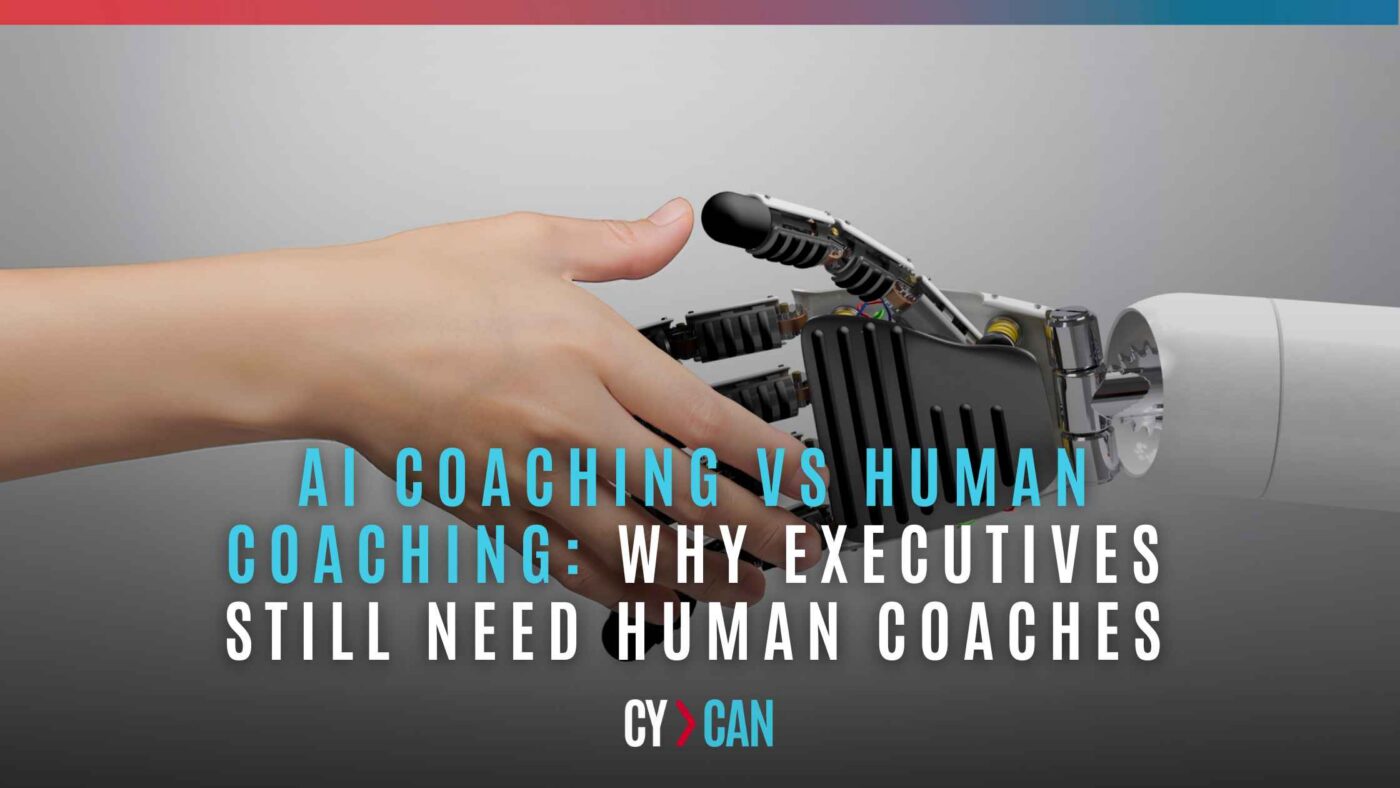
If an AI can ask sharp questions, test your assumptions and provide leadership advice in a couple of seconds, what is a human executive coach needed for?
It is a fair question, and there are already leaders taking action on it.
They use AI to analyse information.
Rehearse difficult conversations.
Test strategic scenarios and sort out their thinking.
They increasingly use it as a coach. Tell it your relationship with the Board is strained and it will assist you in planning the conversation.
Say you are stuck on a decision and it will keep questioning it until the problem appears from a different angle.
The difference between AI coaching versus human coaching becomes clearer when we separate thinking from understanding. AI is a very good thinking partner. But thinking and understanding are different things.
AI assists leaders to explore what they think, but a skilled coach can help them understand why they think it, what sits underneath, how it influences their leadership and what they may not yet be prepared or able to see.
The International Coaching Federation (ICF) has published a framework for AI coaching that recognises that AI can support reflection, learning and decision-making, either independently or alongside human coaching.
The ICF describes AI coaching as a resource that can be used “independently or in conjunction with human-to-human coaching activities”.
But its framework also makes an important distinction about where AI may be most valuable. Discussing a blended approach, the ICF argues that using AI well can allow coaches to spend more time on “complex, transformational coaching in the human-to-human domain”.
That distinction matters.
It highlights that AI can support parts of the coaching process. It can make reflection more accessible, help people think through problems and provide another way for leaders to explore their decisions.
But there are parts of coaching that depend on what happens between two people.
So the useful question is not whether AI can coach.
It is where AI helps, where a human coach helps, and what leaders lose when they treat the two as interchangeable.
A coach sees what an AI can not
Consider an executive that states: “I think my leadership team needs to become more accountable.”
An AI can work with that.
It might ask what accountability looks like at the moment.
Suggest possible causes.
Draft questions for the team or help build an action plan.
A coach hears more. They see where the sentence trails off and where the problem is described with frustration.
They remember that three sessions ago the same person was struggling to delegate.
Whenever they discuss accountability, the executive spends most of the conversation on what everyone else must change.
Eventually the question shifts from “How do I make my team more accountable?” to “What am I doing that makes accountability hard for this team?”
No new information arrived to make that shift. Somebody was watching closely enough to notice what the leader had not yet seen.
The problem you bring is not the whole problem
Executives work while balancing competing priorities, history, power and pressure. The issue that opens a coaching conversation is often a doorway.
A challenging Board relationship may turn out to involve a habit of avoiding conflict.
A struggling executive team may have a CEO who is used to becoming the decision-maker for everything.
A change programme may be led by someone who backs it intellectually while grieving the organisation that came before.
A good coach listens for the patterns, contradictions and emotions around the stated problem.
Sometimes a leader needs friction, not help
AI is very good at being helpful, which is a strength and also a limitation.
Development does not always need helpfulness. Sometimes an executive needs someone to stay with an uncomfortable question instead of rushing them towards a solution.
Take the leader who says, “That’s just the way I am.”
A coach might reply: “Is that who you are, or is it a behaviour that has worked for you until now?”
Generating a difficult question is easy. Knowing whether this person needs challenging today, how far to push and when silence will do more than another question is judgement.
AI works from your version of events
When you coach yourself with AI, you decide what it knows.
That is a problem especially when your description of the situation is part of the problem.
Say an executive believes two members of their team are resisting change, and explains this to an AI. The reply will take that framing as given and move on to communication plans and stakeholder engagement.
But what if those two people are not resisting change at all?
What if they are resisting the way it is being led?
A coach does not have to accept the leader’s account as fact. They can ask why the executive calls these people resistant, what the evidence is, what the two would say if asked, how the change was announced, and what would become uncomfortable if their view turned out to be right.
At that point coaching has stopped solving the problem and started checking whether it is the right one.
Human coaching helps you see the blind spots
Nobody sees themselves objectively, and seniority makes honest feedback harder to come by.
The higher someone rises, the more carefully people choose their words.
Colleagues soften disagreement.
Teams learn which topics are safe.
A leader can end up surrounded by information and short on truth.
A coaching relationship offers a place to examine yourself without office politics in the room.
The questions change. “What answer should I give?” becomes “What does my reaction to this tell me?”
And “How should I handle this person?” becomes “Why does this person provoke such a strong response in me?”
Knowing something is not the same as changing
Most leaders already know they should delegate, have the difficult conversation and listen more.
Awareness is seldom the gap.
The hard part is turning it into behaviour often enough for anything to shift.
A coach remembers what you committed to last time. They ask what happened when you tried something different, and why an agreed action got avoided. They spot the same challenge returning in a new disguise. Over months, patterns become visible and progress can be seen.
An AI waits for you to come back to it.
A coach is expecting you.
Leaders work inside a system
Every executive’s behaviour ripples outwards into colleagues, culture, decisions and succession.
A CEO who becomes more decisive may switch off challenges from the team.
A leader who wants to empower people may hand over responsibility without handing over authority.
A team that wants to move ahead faster may cut the very conversations that let disagreement surface.
This is why executive and executive team coaching can not be reduced to individual tips.
A coach keeps bringing the leader back to the wider picture.
What effect is this behaviour having on others?
How is the team responding?
Are you rewarding certain behaviours without realising it?
What does the organisation need from you now, and how will that change as it grows?
The goal is a leader who needs the coach less
If coaching only produced better answers, ever more capable AI would win the argument.
But the purpose of executive coaching is to strengthen the leader’s own ability to think, question, decide and lead.
A good coaching relationship leaves the leader better at coaching themselves.
They recognise their own patterns, question their own certainty, stay with challenges a little longer before reaching for an answer, and understand more clearly how they land with other people.
That capability can not be downloaded.
Where AI coaching can strengthen human coaching
None of this is an argument for keeping AI out.
Between sessions, leaders can use it to structure their reflections.
Run through alternative scenarios.
Prepare for a conversation.
Test an early idea or turn a lesson into concrete actions.
It is available the moment a thought occurs, and it can make reflection more frequent than a monthly session ever could.
Early research is looking at hybrid models in which technology supports human coaching instead of replacing it, and the ICF expects AI to be used alongside human-to-human coaching, with standards meant to make that responsible.
What the moment requires
AI will keep improving.
Its questions will get better and its conversations more natural.
Organisations should welcome that.
But keep in mind that leadership is practised between people. Trust, conflict, influence and culture all live in relationships, and many of the hardest leadership problems come from how a leader relates to themselves, to others and to the system around them, more than from what they know.
So the better question is not whether AI can coach executives. It plainly can do a growing share of coaching-related work.
The better question is when a challenge needs more than an intelligent reply.
Sometimes a leader needs information.
A framework.
A different way of looking at things.
And sometimes they need another person who will listen closely, challenge courageously and understand the context well enough to help them see what they could not see alone.
Leadership development in an AI-enabled world
At Cycan, we think technology should widen what leaders can do and leave intact the relationships that develop them.
Our executive and executive team coaching looks past the immediate problem to the thinking, behaviour, relationships and organisational dynamics behind it, whether you are a single executive, a team realigning, or an organisation in the middle of change. The aim is a leader who keeps asking better questions long after the sessions have ended.
The aim is a leader who keeps asking better questions long after the sessions have ended.
If you are ready to look more deeply at how you think, lead and respond to the challenges around you, explore our executive coaching services and discover how the right coaching relationship can support your leadership development.