How can every executive be meeting their objectives while the...
Read More
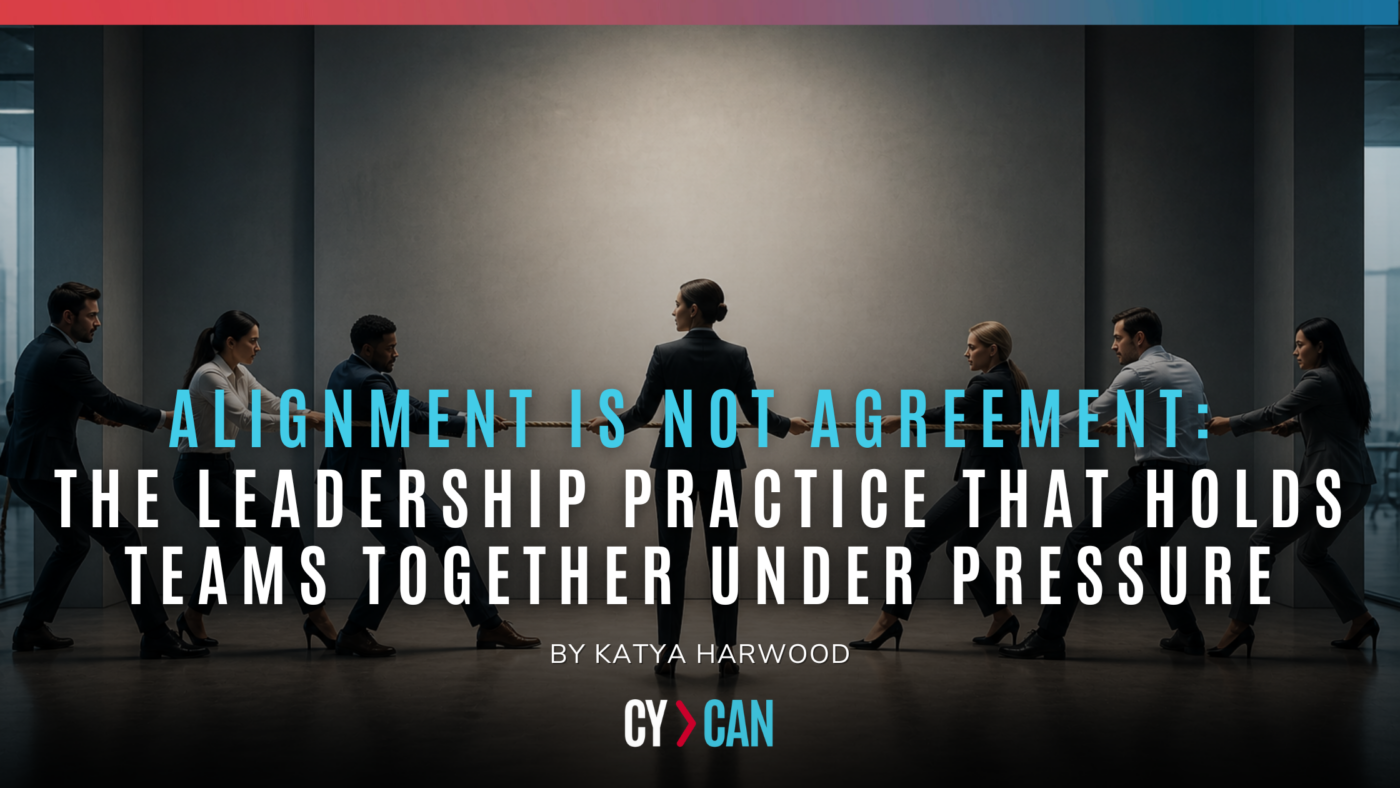
Leadership teams do not lose alignment because they disagree.
In fact, many leadership teams that are drifting apart still agree on most things.
They agree on strategy.
They agree on targets.
They agree on what needs to be done.
And yet, something beneath that agreement begins to loosen.
It shows up in subtle ways. In the slight hesitation before someone speaks. In the decisions that feel technically sound but strangely disconnected. In the growing sense that while everyone is present, not everyone is truly aligned.
This is the quiet paradox of leadership.
Agreement can exist without alignment.
But alignment cannot exist without something deeper.
Because alignment is not built on what is said in the room.
It is built on how leaders relate to one another when the conversation becomes difficult, when perspectives diverge, and when the pressure to move quickly begins to outweigh the discipline of moving together.
This is where many leadership teams begin to drift.
Not because they lack capability, but because they lose connection to the very thing that holds their capability together.
Most leadership teams operate with a high degree of coordination.
There are structured meetings.
Clear reporting lines.
Defined responsibilities.
Everything appears organised.
But coordination is not alignment.
Coordination ensures that work moves forward.
Alignment ensures that it moves forward with coherence.
Without alignment, leaders begin to optimise their own areas rather than the whole. Decisions become locally effective but globally misaligned. Communication becomes efficient but less meaningful. And over time, the organisation begins to feel the tension between movement and direction.
This is not a failure of process.
It is a signal that something relational has shifted.
Alignment does not disappear in a single moment.
It weakens gradually, often in ways that are difficult to detect while they are happening.
A leader begins to withhold perspective because it feels unnecessary to challenge.
Another begins to push decisions through more quickly because it feels more efficient.
Another stops engaging fully because the space no longer feels as open as it once did.
Each of these moments is small.
But alignment is not lost in one moment.
It is lost in the accumulation of them.
Over time, the leadership team begins to operate with less shared ownership and more individual interpretation. The conversations continue, but the connection within them becomes thinner. The decisions continue, but the commitment behind them becomes less certain.
And eventually, the team begins to feel different.
Not obviously broken.
But no longer fully together.
Strong leadership teams do not rely on alignment happening naturally.
They create it intentionally.
Not through frameworks alone, but through disciplined reflection. Through questions that go beyond performance and into the way the team actually operates as a collective.
These are not questions to be answered quickly.
They are questions to be sat with.
Questions that bring the team back into alignment not just around what they do—but around how they lead together.
Are we still clear on what truly matters, or have we allowed urgency to redefine our priorities without noticing?
Because urgency has a way of reshaping focus, and without deliberate reflection, teams begin to respond to what is loud rather than what is important.
Do we experience this team as a space where honest challenge is welcomed, or one where disagreement is quietly managed?
Because alignment requires tension, but only when that tension can exist without damaging trust.
When we make decisions, do we leave the room with shared conviction, or with individual interpretations of what has been agreed?
Because alignment is not agreement in the moment, but commitment beyond it.
What conversations are we currently avoiding, and what is the cost of continuing to avoid them?
Because avoidance does not remove tension. It relocates it.
Do we see ourselves as a leadership team with collective responsibility, or as individuals accountable primarily for our own domains?
Because alignment cannot exist where responsibility is fragmented.
Where might we be unintentionally working against one another, even while believing we are aligned?
Because misalignment often hides in execution, not intention.
And finally, what does alignment require from each of us personally, beyond what we expect from the team as a whole?
Because alignment is sustained not by collective intention alone, but by individual accountability.
These questions do not resolve alignment.
They reveal it.
And in that revelation, they create the possibility for something stronger.
Alignment is not maintained through agreement.
It is maintained through relationship.
Through the willingness to remain engaged when it would be easier to withdraw. Through the courage to speak when silence feels safer. Through the discipline of listening not only to respond, but to understand.
This is where many leadership teams struggle.
Because relationship requires something that structure does not.
It requires presence.
And presence is not always convenient.
It asks leaders to slow down when pressure is high.
To remain open when perspectives conflict.
To stay connected when tension rises.
But it is in these moments that alignment is either strengthened or weakened.
Not in the strategy session.
But in how the team chooses to show up within it.
There is a point at which alignment stops being a team issue.
And becomes an individual one.
Each leader carries a responsibility that cannot be delegated.
To notice their own patterns.
To reflect on their own contribution.
To recognise where they may be reinforcing the very misalignment they are trying to resolve.
Because alignment does not break down in abstraction.
It breaks down in behaviour.
In how leaders communicate.
In how they respond to challenge.
In how they navigate pressure.
And until that level of awareness is present, alignment remains fragile.
Leadership teams often look for a turning point.
A moment where alignment is restored.
But alignment does not return through a single conversation.
It returns through consistency.
Through repeated moments where leaders choose clarity over convenience, honesty over comfort, and shared responsibility over individual positioning.
It returns when the team begins to trust not only the outcome of conversations, but the integrity within them.
And over time, something begins to shift.
The conversations deepen.
The decisions strengthen.
The sense of shared ownership returns.
Not perfectly.
But meaningfully.
Alignment is not something leadership teams achieve.
It is something they practise.
Quietly. Consistently. Intentionally.
It lives in the spaces between decisions.
In the quality of conversations.
In the courage to remain connected when it matters most.
Because in the end, alignment is not about agreement.
It is about whether a leadership team is willing to do the work required to stay together in a way that truly serves the whole.
If your leadership team is moving forward but not fully together, it may not be a strategy issue.
It may be an alignment one.
At Cycan, we work with leadership teams to strengthen alignment at its source—through trust, clarity, and conscious leadership practice.
If this resonates, we invite you to begin a deeper conversation:
How can every executive be meeting their objectives while the...
Read MoreWhat does it cost your organisation when the person who...
Read MoreIf an AI can ask sharp questions, test your assumptions...
Read MoreWhat if the behaviours holding your organisation back are not...
Read MoreWe use cookies to enhance your browsing experience, serve personalised ads or content,
and analyse our traffic. By clicking "Accept All", you consent to our use of cookies.