What if the behaviours holding your organisation back are not...
Read More
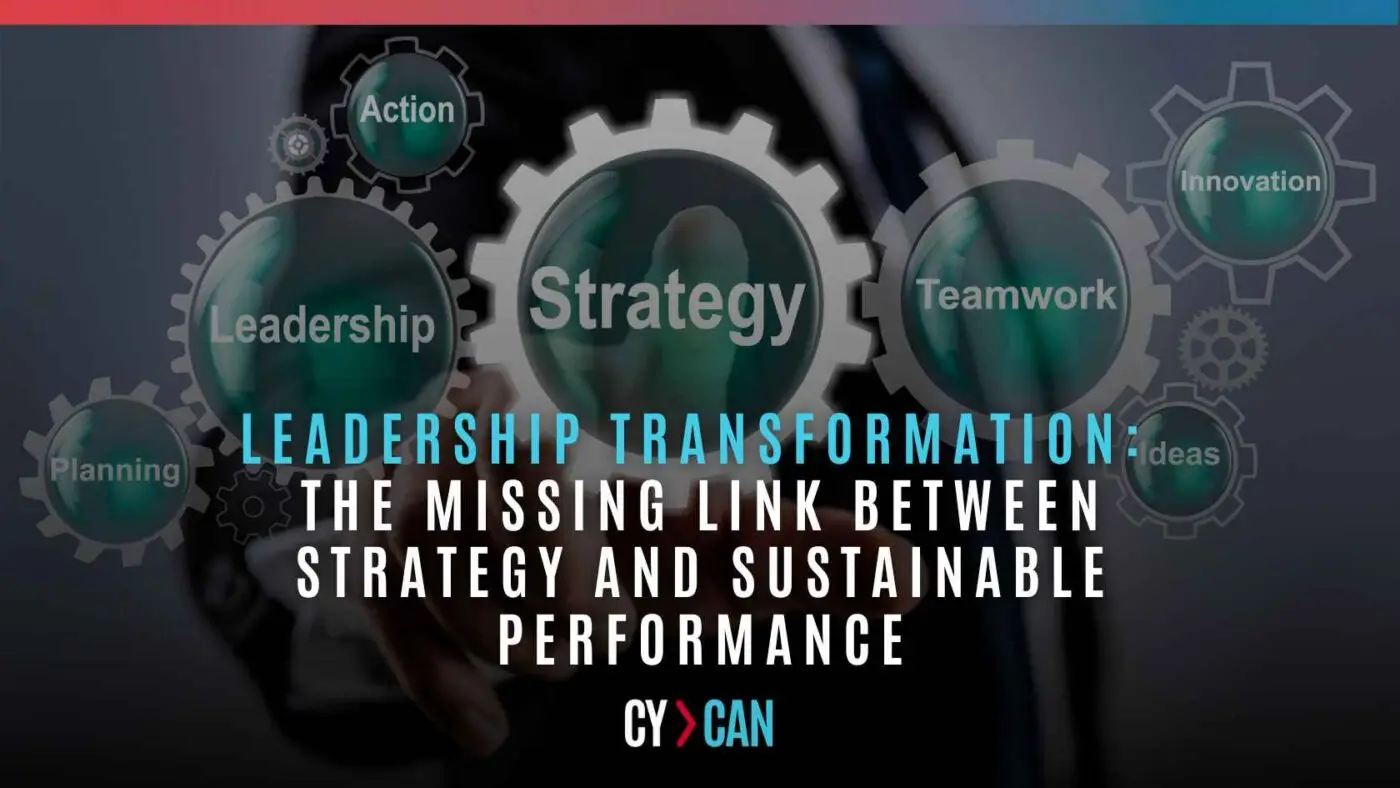
What if the reason your strategy is not delivering its full potential has less to do with the strategy itself and more to do with the leadership required to make it real?
Organisations invest enormous amounts of time, intellectual energy and capital defining where they want to go. Boards debate strategic priorities. Executive teams establish growth ambitions. Consultants help redesign operating models. Transformation programmes are launched, technology investments are approved and ambitious targets are communicated across the business.
Yet strategy on paper and strategy in practice are two very different things.
Between the two sits leadership.
A strategy may identify where an organisation wants to go, but leaders determine whether people understand that direction, believe in it, make decisions consistent with it and translate it into everyday behaviour. When leadership capability does not evolve alongside strategy, the organisation eventually encounters a gap between ambition and execution.
That gap matters more than ever.
The 2025 Deloitte Global Human Capital Trends research frames the challenge facing organisations around three fundamental questions: whether the right work is being done in the right way, whether organisations can access and develop the workforce they need, and whether they have the organisation and culture required to enable performance. Deloitte’s research drew on nearly 13,000 business and HR leaders across 93 countries, illustrating the scale at which leaders are grappling with increasingly complex choices about people, technology, performance and organisational design.
This is where leadership transformation becomes critical.
At Cycan, we do not see leadership transformation as another leadership programme or a collection of workshops designed to improve individual competencies. We see it as the deliberate process of ensuring that the organisation has the leadership behaviours, capability, culture and collective effectiveness required to turn strategy into sustained performance.
Because when the organisation changes, leadership must change with it.
Most strategies contain assumptions about leadership, even when those assumptions are never explicitly stated.
A growth strategy may assume leaders can delegate more effectively and build capability beneath them. A digital transformation may assume executives can make decisions in unfamiliar territory and lead people through uncertainty. A customer-centric strategy may require functions to collaborate differently. An acquisition may require leaders to integrate cultures and establish trust quickly. An innovation strategy may depend on people feeling safe enough to challenge existing assumptions.
The strategic document may never say any of this. But the leadership requirement is there.
Recent research reinforces the connection. A 2025 study published in Organizational Dynamics argues that effective strategy implementation depends on internal alignment across strategy, organisational structure, controls, culture, resources, capabilities and leadership. The authors emphasise that organisations need the appropriate leadership in place and must ensure that the wider organisational system supports the strategy.
Research from Stanford Graduate School of Business adds another dimension. Researchers surveyed 262 CEO alumni of Harvard Business School and found that organisations whose CEOs used more structured strategy practices grew faster and were more profitable than peers, with the relationship particularly pronounced in more strategically complex industries. The research also suggests that CEO practice itself contributes to those differences in performance.
The implication is important.
Strategy execution is not simply a matter of communicating the plan more effectively.
It is a leadership capability.
If the organisation asks leaders to execute a fundamentally different strategy while they continue thinking, deciding, collaborating and leading in fundamentally the same way, transformation will eventually reach its limits.
This distinction matters.
Traditional leadership development often starts with the individual.
Those remain valuable questions, but leadership transformation begins somewhere else. It begins with the organisation.
What future are we trying to create, and what must leadership become for that future to be possible?
That question changes the conversation.
Instead of beginning with a programme catalogue, the organisation begins with its strategic reality. It considers the capabilities required to execute the strategy, the leadership behaviours that will enable or inhibit progress, the culture those behaviours create, the strength of the executive team and the leadership depth required to sustain performance beyond today’s incumbents.
Leadership development can then become one mechanism within a much larger transformation.
Executive coaching may be required.
Executive-team interventions may be necessary.
New leadership capability may need to be acquired externally.
Existing leaders may need to develop differently.
Decision rights may need to change.
Leadership rhythms may need to evolve.
Succession pipelines may require attention.
The organisation may need to address the culture created by leadership behaviour rather than simply communicating new organisational values. This is why Cycan views leadership transformation as a connected organisational discipline rather than an event.
Organisations frequently look downwards when transformation loses momentum.
Those questions have their place, but transformation also requires leaders to look upwards.
This becomes particularly important because leaders have a disproportionate effect on how work is experienced.
Gallup has long found that managers account for a substantial proportion of the variance in team engagement. Its 2025 State of the Global Workplace report reiterates that 70% of team engagement is attributable to the manager.
More recent Gallup data shows why organisations should pay attention to leadership capacity itself. Its 2026 State of the Global Workplace reports that global manager engagement fell from 27% in 2024 to 22% in 2025. By contrast, Gallup found that 79% of managers in its best-practice organisations were engaged.
If leaders are expected to carry transformation while they themselves are overwhelmed, disengaged, unclear or insufficiently equipped for what the organisation now requires, the transformation problem becomes predictable.
Organisations cannot continually add complexity to leadership roles without also transforming leadership capability.
One of the most important shifts in business transformation leadership occurs when an organisation stops treating leadership as the sum of individual executives.
You can have an exceptional CFO, an exceptional CHRO, an exceptional COO and an exceptional commercial leader and still have an ineffective executive team.
Individual excellence does not automatically create collective effectiveness. This matters because strategy increasingly crosses functional boundaries.
Customer experience does not belong to one function. Digital transformation does not belong to IT. Culture does not belong to HR. Innovation does not belong to a single innovation team.
Organisational transformation cannot belong solely to a transformation office.
These outcomes depend on leaders working across boundaries, making enterprise-level decisions and accepting collective responsibility for results that no single function can deliver independently.
Leadership transformation therefore requires a shift from:
My function to our organisation.
My priorities to our strategy.
My success to our collective performance.
My authority to our shared accountability.
This is one reason Executive Team Effectiveness & Alignment forms an important part of the wider leadership transformation conversation at Cycan. The goal is not to make executive teams agreeable. It is to create teams capable of challenging one another, making difficult decisions, maintaining strategic alignment and leading the organisation collectively.
Healthy executive teams do not avoid disagreement. They create enough trust and clarity to use disagreement productively without allowing it to fragment execution.
There is another uncomfortable reality organisations need to confront. Not every future leadership capability can be developed internally, and not every existing leader will necessarily be the right leader for the organisation’s next chapter. Leadership transformation therefore includes decisions about acquisition as well as development.
When strategy changes significantly, organisations should ask whether their current leadership capability matches the future they are trying to create.
This is where retained executive search becomes part of the transformation architecture rather than an isolated recruitment exercise. Cycan’s approach to Executive Search and Leadership Acquisition starts with the strategic, cultural and leadership demands of the role, because the objective is not simply to fill an executive vacancy. It is to strengthen the leadership capability available to the organisation.
The distinction matters.
A technically outstanding executive who succeeded in yesterday’s environment may not necessarily be the leader required for tomorrow’s organisation.
Transformation requires organisations to appoint for the future they are creating.
Finding the right leader is only one part of the equation.
Organisations can spend months identifying an executive and then reduce integration to introductions, systems access, policy documents and a 30-60-90-day plan.
That leaves significant value on the table.
New executives enter complex human systems. They inherit relationships, history, expectations, tensions, cultural norms and informal networks that rarely appear in an organisational chart.
They need to understand not only what the organisation does but how it really works.
Effective executive integration accelerates the point at which an appointment becomes organisational capability.
This is why Cycan’s broader approach connects acquiring leadership with integrating it. Executive transformation cannot stop when the contract is signed.
Once the organisation understands the leadership its strategy requires, development becomes much more purposeful.
The question changes from:
What training should our leaders attend?
to:
What must our leaders become capable of doing that they cannot consistently do today?
That might involve leading across boundaries, navigating ambiguity, creating accountability without command and control, developing others, thinking systemically, strengthening executive presence or leading through significant cultural change.
It also requires organisations to reconsider how development happens.
Deloitte’s 2025 Human Capital Trends research found that 73% of organisations recognise the importance of reinventing the manager role, yet only 7% report making great progress. The same research found that 66% of managers and executives believe most recent hires are not fully prepared for their roles.
Those findings point to a wider challenge: organisations cannot assume that experience alone will continually produce the leadership capability they need.
Development needs intentionality.
Cycan’s Leadership Transformation offering reflects this through interventions such as Leader as Coach, Leadership Alchemy and Systemic Team Coaching. The Leadership Alchemy Programme, for example, focuses on areas including self-awareness, leadership presence, systemic thinking, feedback, engagement, innovation and how leaders’ thinking, language and behaviour affect others.
The purpose is not development for development’s sake.
It is behaviour change that improves the organisation’s capacity to perform.
One of the reasons transformation programmes lose momentum is that organisations often define transformation through initiatives.
An organisation can claim to value collaboration while rewarding individual functional performance. It can talk about empowerment while senior leaders retain every significant decision. It can promote innovation while punishing intelligent failure. It can call for openness while executives react defensively when challenged.
People notice the contradiction.
Leadership transformation closes the distance between the leadership behaviours an organisation says it wants and the leadership behaviours people actually experience.
Transformation is often spoken about as though there is a destination.
There rarely is.
Organisations move from one period of change into another.
PMI’s 2025 global research captures the scale of that reality. In a companion survey of senior executives, 93% said they needed to rethink or reinvent their business model or operating approach at least every five years, with almost two-thirds doing so every two years or more frequently. Two-thirds reported accelerating digital and AI transformation.
If reinvention is becoming continuous, leadership transformation cannot be episodic.
The organisation cannot afford to wait until leaders are visibly struggling before strengthening capability.
Nor can it run a leadership transformation programme once and assume the problem has been solved.
Sustainable performance requires leadership systems capable of continuing to adapt.
This means developing leaders.
Strengthening executive teams.
Building succession depth.
Integrating new executives.
Acquiring capabilities that do not exist internally.
Embedding new leadership behaviours.
And continually asking whether the organisation’s leadership remains fit for its strategic future.
This is the connection between leadership transformation and leadership continuity.
Transformation creates the leadership capability required for change.
Continuity ensures that capability does not disappear when individual leaders move on.
At Cycan, we believe leadership transformation should connect the entire leadership lifecycle. It begins by understanding what the organisation is trying to achieve and the leadership required to make that future possible.
From there, organisations need to:
Acquire the leadership capability they do not currently possess.
Develop leaders so capability continues evolving alongside strategy.
Align executive teams so strong individuals become a strong collective leadership system.
Sustain that capability through succession, leadership depth, organisational effectiveness and continuity.
This is not a neat sequence that organisations complete once.
It is an ongoing leadership discipline. A new strategy may expose a capability gap. An executive appointment changes team dynamics. Growth creates new development requirements. A transformation tests leadership alignment. A succession decision exposes insufficient depth.
Each creates another leadership question.
The organisation’s ability to respond determines whether transformation becomes temporary activity or sustainable capability.
Organisations will continue investing in strategy.
They should.
They will continue investing in technology, operating models, transformation programmes and new ways of working.
They should do that too.
But none of these investments operate independently of leadership.
Leadership determines how strategy is interpreted. Leadership influences whether people trust the direction. Leadership shapes culture. Leadership affects the quality of decisions. Leadership determines whether functions compete or collaborate. Leadership develops, attracts and retains capability. Leadership decides whether transformation survives contact with organisational reality.
This is why leadership transformation should not sit at the edge of business transformation.
It belongs at its centre.
The question for CEOs, Boards and executive teams is therefore not simply whether the organisation has a transformation strategy.
It is whether the organisation is transforming its leadership at the same speed.
At Cycan, we work with organisations that recognise that sustainable transformation requires more than a new strategy or another leadership intervention.
We help organisations connect the leadership lifecycle, from acquiring and integrating the right executive capability to developing leaders, strengthening executive teams and building the continuity required to sustain performance over time.
If your organisation is navigating growth, transformation, a shift in strategy or a significant leadership transition, this is the moment to examine whether your leadership capability is evolving quickly enough to support where the business is going.
Explore Cycan’s Leadership Transformation approach and Leadership Alchemy Programme, or discover how Cycan strengthens leadership through Executive Search, Executive Coaching and Executive Team Effectiveness.
Book a strategic conversation with Cycan.
Because if leadership is the mechanism through which strategy becomes behaviour, culture, decisions and ultimately performance, can your organisation truly transform without transforming the leadership required to take it there?
What if the behaviours holding your organisation back are not...
Read MoreWhat happens when the leadership that made your organisation successful...
Read MoreWhat if the reason your strategy is not delivering its...
Read MoreWhat happens when every executive in the room is capable,...
Read MoreWe use cookies to enhance your browsing experience, serve personalised ads or content,
and analyse our traffic. By clicking "Accept All", you consent to our use of cookies.