What happens when every executive in the room is capable,...
Read More
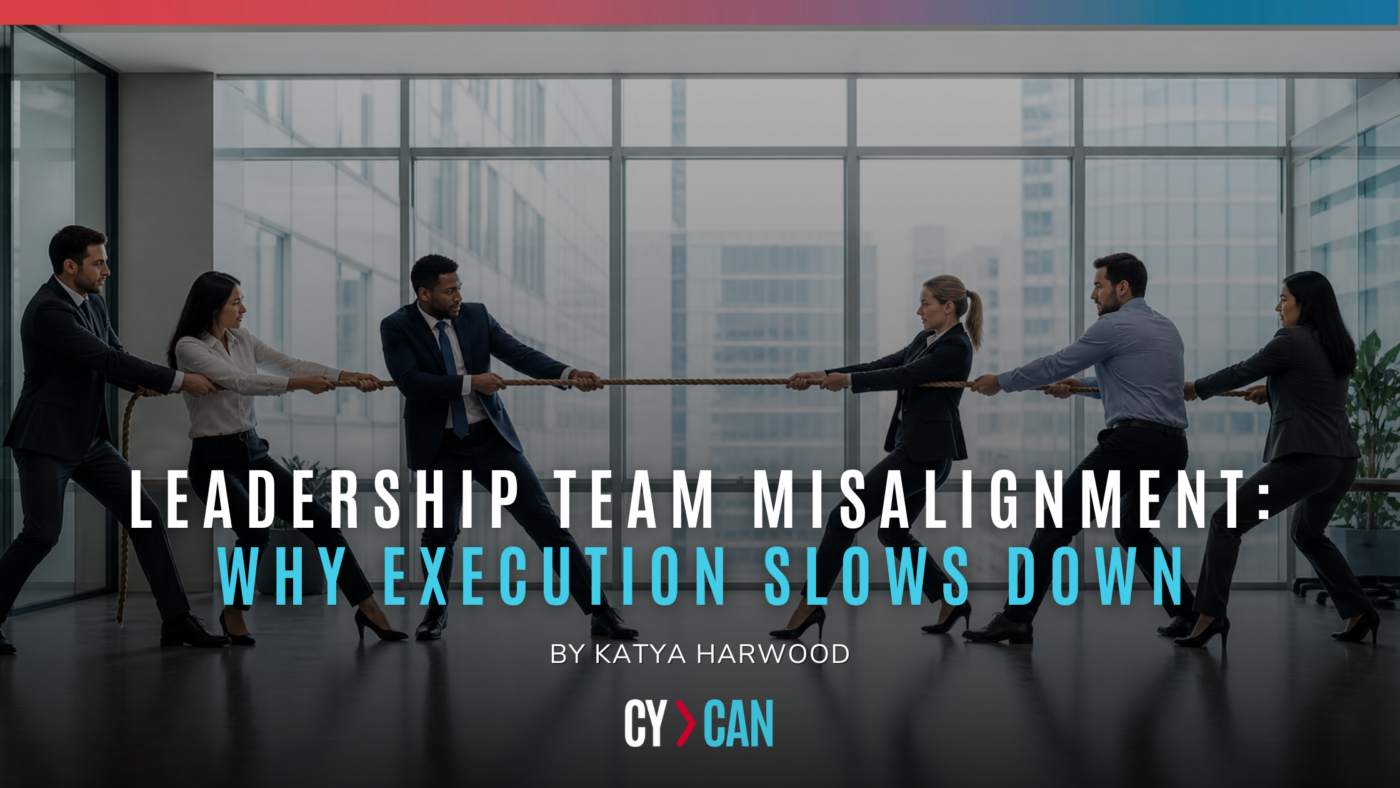
Leadership teams don’t lose alignment all at once.
It usually starts when execution becomes heavier than it should be.
Deadlines slip not because capability is missing, but because decisions don’t land cleanly.
Conversations take longer, but resolve less.
Priorities are agreed, but carried differently across the business.
Nothing is visibly broken.
But something is no longer working as it should.
This is the early signal of leadership team misalignment.
And in most organisations, it is already costing more than it appears.
Because when alignment weakens at the top, the impact doesn’t stay contained. It shows up in slower execution, inconsistent decisions, and teams that spend more time interpreting direction than acting on it.
At Cycan, we see this most often in organisations facing moments of pressure, growth, leadership change, or transformation.
The issue is rarely strategy.
It is how the leadership team is operating together.
Most leadership teams believe they are aligned.
They’ve sat in the same strategy sessions.
They’ve agreed on priorities.
They communicate a consistent direction.
But alignment, in practice, is not defined by shared exposure to strategy.
It is defined by shared interpretation.
Two leaders can agree on a priority and act on it in completely different ways.
Two functions can pursue the same goal and create friction in the process.
This is where the problem begins.
Not between strategy and execution, but between leaders themselves.
And when that gap is not addressed, the organisation starts to feel it:
This is not a strategy problem.
It is a leadership coherence problem.
In more stable conditions, organisations can absorb misalignment.
Processes compensate.
Structures provide clarity.
Time allows for correction.
But that is no longer the environment most leadership teams operate in.
Today’s organisations are navigating:
In this context, leadership team unity is not a cultural ideal.
It is a performance requirement.
Because when leadership teams are truly unified:
And when they are not, the cost compounds—quietly at first, then systemically.
Leadership teams rarely fracture dramatically.
They drift.
Through patterns that seem small in isolation:
Over time, these patterns accumulate.
And what begins as minor misalignment becomes structural:
Leaders start operating in parallel, not together.
Trust becomes selective.
Alignment becomes performative.
The challenge is that none of this is immediately visible.
Which is why it persists.
Unity is not built through intention.
It is built through behaviour; repeated consistently, especially under pressure.
These are six behaviours we consistently see in leadership teams that sustain coherence over time.
Strong teams don’t just share decisions.
They share how those decisions are reached.
They articulate assumptions.
They expose reasoning.
They invite challenges before alignment is declared.
This creates clarity and trust.
Because when thinking is visible, alignment becomes real.
Without it, leaders may agree on what, but remain misaligned on why.
And it is the “why” that shapes execution.
Most teams avoid tension.
Effective teams work with it.
They recognise that disagreement is not a threat to unity, it is a requirement for it.
But only if it is held collectively.
This means:
When tension is avoided, it doesn’t disappear.
It relocates.
Into side conversations.
Into delayed decisions.
Into quiet resistance.
Unity is not the absence of tension.
It is the ability to stay in it; together.
Agreement is not alignment.
Leadership teams need to go further, ensuring they are aligned on how strategy is understood and applied.
This requires asking:
Because misalignment rarely comes from disagreement. It comes from differences that never surfaced. When interpretation is aligned, execution becomes lighter.
This is where many leadership teams fracture.
A decision is made collectively. But carried inconsistently.
Leaders leave the room and:
Not always intentionally. But enough to create confusion.
Unified teams do something different.
They treat decisions as shared commitments, not individual options.
They carry them consistently.
They reinforce them publicly.
They align their teams accordingly.
Because unity is not tested in the meeting.
It is tested in what happens after.
Unity is not sustained through occasional alignment.
It is sustained through rhythm.
Consistent spaces where leaders:
Without this, alignment decays.
Not because leaders disengage—but because the organisation moves faster than the team reconnects.
Rhythm keeps unity intentional, not reactive.
In fragmented teams, accountability is individual.
In unified teams, it is collective.
Leaders don’t just own their function.
They own the system.
They step into challenges beyond their area.
They support decisions that may not originate from their domain.
They see success as shared not siloed.
This is the shift from a group of leaders to a leadership system.
And that is where unity becomes real.
The cost of misalignment is rarely immediate.
It accumulates.
Decisions require more clarification.
Execution requires more coordination.
Energy is spent on alignment instead of progress.
Over time, the organisation becomes:
And often, the response is to look outward:
New strategy.
New structure.
New hires.
But the underlying issue remains.
Because the problem is not what the organisation is doing.
It is how the leadership team is operating—together.
Most organisations treat unity as something to achieve.
An outcome.
A milestone.
But in practice, unity is not something you reach.
It is something you maintain.
Through how conversations are held.
Through how decisions are made.
Through how tension is navigated.
Through how alignment is sustained over time.
When leadership team unity weakens, the question is not:
“What are we doing wrong?”
It is:
These are not comfortable questions.
But they are the ones that reveal what is actually happening.
Because misalignment rarely announces itself.
It shows up in friction.
In complex environments, leadership is not just about direction.
It is about coherence.
The ability of a group of leaders to:
Think together.
Decide together.
Act together.
Not perfectly.
But consistently enough that the organisation feels it.
Because organisations don’t experience leadership as individuals.
They experience it as a system.
And when that system is coherent, everything downstream becomes clearer.
More consistent.
More effective.
More aligned.
If any of these patterns feel familiar, it is worth paying attention.
Not because something is broken—but because something is beginning to strain.
Leadership misalignment rarely resolves itself through more effort.
It requires a shift in how the leadership system operates.
At Cycan, we work with leadership teams at exactly this point—when execution is still working, but becoming heavier than it should be.
We help leaders:
If your leadership team is navigating growth, pressure, or transformation—and alignment is becoming harder to hold—this is the work.
Visit www.cycan.co.za to start a conversation.
Because when leadership teams operate as one system, everything downstream becomes more focused, more consistent, and more effective.
Not:
“Are we aligned?”
But:
“Are we operating as one leadership system—or as many?”
Because the answer to that question doesn’t just shape leadership. It shapes execution, culture, and ultimately performance.
What happens when every executive in the room is capable,...
Read MoreWhat if the greatest cost to your organisation isn’t one...
Read MoreWhen was the last time your executive team had a...
Read MoreWhat does it really cost an organisation when its leaders...
Read MoreWe use cookies to enhance your browsing experience, serve personalised ads or content,
and analyse our traffic. By clicking "Accept All", you consent to our use of cookies.