What happens when every executive in the room is capable,...
Read More
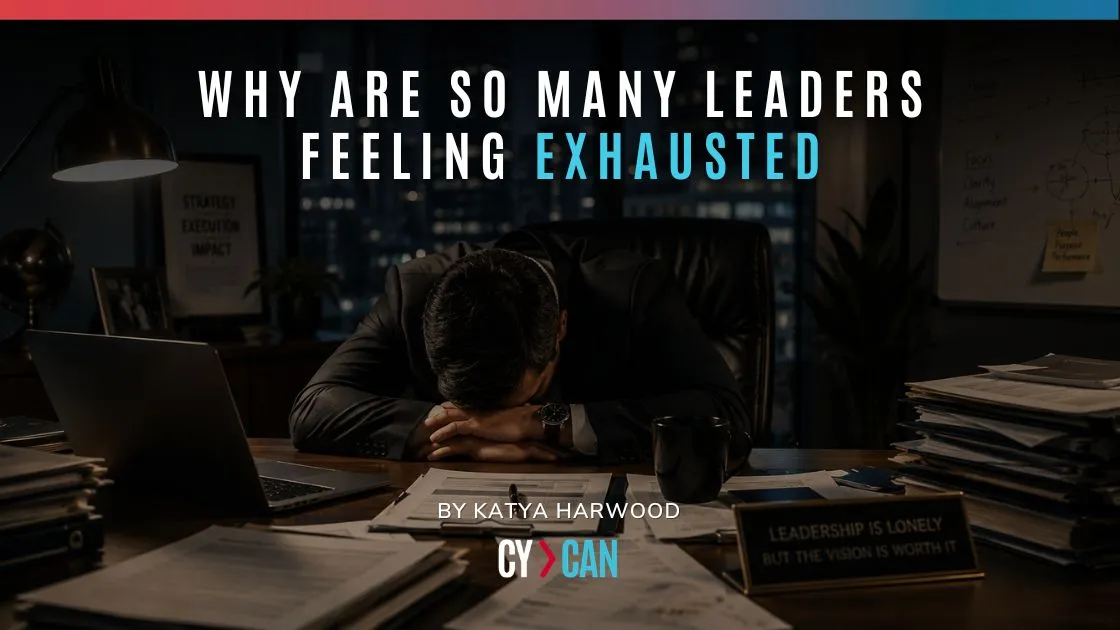
What happens to an organisation when the people responsible for carrying its vision begin running out of the energy required to sustain it?
Most leadership fatigue does not arrive dramatically.
It does not announce itself through a crisis, a resignation letter, or a sudden collapse in performance.
Instead, it enters quietly.
It settles into conversations that become increasingly transactional. It appears in meetings where people speak, but no longer challenge one another. It reveals itself in leaders who continue showing up every day, meeting deadlines, driving performance, and carrying responsibility, yet somewhere beneath the surface, something begins to shift.
The curiosity that once fuelled innovation starts giving way to caution.
The energy that once inspired teams becomes increasingly difficult to access.
The vision that once felt clear becomes buried beneath operational demands, constant change, competing priorities, and an endless stream of decisions.
From the outside, everything may still appear functional.
Targets may still be achieved.
Strategies may still be implemented.
Reports may still reflect progress.
Yet beneath the visible structures of the organisation, leadership begins experiencing something many businesses struggle to recognise until it has already affected culture, performance, and long-term sustainability.
Leadership fatigue.
Not burnout in its most obvious form.
Something more subtle.
Something more dangerous.
The gradual depletion of the emotional, mental, and relational capacity required to lead effectively through complexity.
For years, organisations have focused heavily on employee wellbeing, engagement, and resilience. These conversations matter deeply, yet one of the most overlooked realities in modern business is that leaders themselves are increasingly carrying extraordinary levels of pressure while receiving diminishing opportunities for recovery, reflection, and renewal.
Research from Gallup has consistently shown that managers experience higher levels of burnout than many other employee groups, particularly as workplace disruption, organisational complexity, and changing workforce expectations continue to increase. More recent workplace studies suggest that leadership fatigue is no longer an isolated challenge affecting a small percentage of executives. It is becoming a widespread organisational reality.
The implications reach far beyond individual wellbeing.
When leaders become exhausted, organisations rarely remain unaffected.
Decision-making changes.
Culture changes.
Relationships change.
Trust changes.
The quality of leadership influences every layer of an organisation, and when fatigue begins shaping leadership behaviour, the consequences often ripple outward long before they become visible on a balance sheet.
This is because leadership is not merely a function.
Leadership is energy.
It is the ability to create clarity during uncertainty, maintain perspective during complexity, and provide direction when others feel overwhelmed.
When that energy becomes depleted, organisations often begin experiencing symptoms they mistakenly attribute to operational problems, performance issues, or market conditions.
In reality, the challenge may be much deeper.
The organisation may be experiencing leadership fatigue.
And many businesses are encountering it more frequently than they realise.
Deloitte’s workplace wellbeing research highlights a growing recognition among executives that organisational success and human sustainability are deeply interconnected. Their findings suggest that wellbeing is not separate from performance, culture, or business outcomes, but a critical driver of all three. At the same time, the research reveals a concerning reality: leadership does not shield people from the pressures of modern work. More than 40% of workers, managers, and executives reported that they frequently feel stressed or exhausted, with those figures becoming even more pronounced at senior leadership levels.
Perhaps most telling is that 66% of managers and 71% of C-suite leaders said they would seriously consider leaving their organisation for one that demonstrated a stronger commitment to supporting their wellbeing, while 59% of employees expressed the same sentiment. The message is becoming increasingly difficult for organisations to ignore: leadership wellbeing is no longer a personal matter. It has become a strategic issue with direct implications for retention, engagement, performance, and long-term organisational sustainability.
The challenge, however, is that many organisations continue treating leadership endurance as though it is limitless.
Leaders are expected to navigate economic uncertainty, technological disruption, organisational transformation, workforce shifts, stakeholder demands, regulatory complexity, and rising expectations for emotional intelligence simultaneously.
The role itself has fundamentally changed.
Yet many leadership models have not evolved accordingly.
A generation ago, leaders were often expected to provide answers.
Today they are expected to create alignment amid ambiguity.
They are expected to manage performance while supporting wellbeing.
Drive results while maintaining culture.
Navigate complexity while remaining emotionally available.
Adapt continuously while creating stability for others.
The demands have multiplied.
The recovery opportunities have not.
This is why leadership fatigue deserves far greater attention than it currently receives.
Not because leaders require sympathy.
Because organisations require sustainability.
A fatigued leadership culture eventually creates a fatigued organisational culture.
And once that cycle begins, performance may continue temporarily, but resilience begins eroding underneath it.
Leadership fatigue rarely appears all at once.
It leaves signals.
Patterns.
Behaviours.
Subtle shifts that reveal something deeper taking place beneath the surface.
The challenge is recognising these signals before they become embedded within the culture itself.
One of the earliest indicators of leadership fatigue is the gradual shift from intentional decision-making to reactive decision-making.
Leaders begin spending more time responding than reflecting.
Urgency replaces strategy.
Short-term pressures consistently override long-term thinking.
Decision fatigue itself has become a growing area of concern within leadership research, particularly as executives manage increasing volumes of information, complexity, and operational demands. When leaders operate in a constant state of cognitive overload, the quality of strategic thinking often begins to decline.
The organisation may still appear busy.
Yet busyness should never be mistaken for clarity.
Fatigued leaders often become risk-averse without consciously realising it.
Not because they lack capability.
Because exhaustion narrows perspective.
When leaders operate from depletion rather than possibility, organisations naturally begin protecting what exists rather than exploring what could emerge.
Ideas receive less attention.
Experiments become harder to justify.
Teams become increasingly cautious.
Over time, innovation declines not because creativity disappears, but because fatigue quietly reduces the willingness to engage with uncertainty.
Healthy leadership creates connection.
Fatigued leadership often defaults to efficiency.
Meetings become shorter but less meaningful.
Communication becomes functional rather than relational.
Leaders focus on outputs, deadlines, and deliverables while unintentionally neglecting the human dynamics that sustain engagement and trust.
This shift is particularly dangerous because culture is built through conversations.
When conversations lose depth, culture eventually loses vitality.
People may still perform.
They simply stop feeling connected to the work, the purpose, and one another.
People rarely leave organisations solely because of workload.
More often, they leave because of leadership experiences.
They leave environments where growth feels limited, communication feels disconnected, or purpose feels absent.
Research continues showing that leadership quality remains one of the strongest influences on employee engagement, retention, and workplace wellbeing. Gallup’s workplace findings consistently reinforce the direct relationship between leadership effectiveness and employee experience.
When leadership fatigue increases, engagement often declines long before turnover data reveals the problem.
The warning signs appear first in morale.
Then in discretionary effort.
Then in retention.
Many modern leaders are carrying increasingly large spans of responsibility.
Recent workplace research suggests managers are overseeing significantly larger teams than they were a decade ago while simultaneously handling more administrative, operational, and technological demands.
The result is predictable.
Leadership becomes consumed by coordination.
Meetings.
Approvals.
Processes.
Reporting.
Administration.
The leader remains busy. Yet leadership itself begins disappearing beneath management activity. People still receive direction. What they stop receiving is presence.
Perhaps the most difficult signal to recognise is when performance remains strong.
Because leadership fatigue does not always produce immediate decline.
In many organisations, high-performing leaders continue delivering exceptional results while quietly exhausting themselves in the process.
Targets are achieved.
Growth continues.
Clients remain satisfied.
Yet beneath the visible success lies a growing sense of depletion.
Energy becomes harder to access.
Optimism becomes harder to sustain.
The organisation begins operating from effort rather than vitality.
This is often where leadership fatigue becomes most dangerous.
Not when performance drops.
When performance masks exhaustion.
Because by the time visible decline appears, fatigue has often been present for much longer than anyone realised.
The solution to leadership fatigue is not simply resilience training, wellness initiatives, or encouraging leaders to take more leave.
Those interventions can help.
But they do not address the deeper issue.
Leadership fatigue is often the result of a widening gap between what leaders are carrying and what organisations are asking them to sustain.
The future of leadership will require something different.
Not stronger leaders.
More conscious leadership.
Leadership that recognises sustainability as a strategic priority rather than a personal luxury.
Leadership that understands recovery is not separate from performance.
Leadership that creates environments where reflection is valued alongside execution.
Leadership that recognises human energy as one of the organisation’s most valuable resources.
The organisations that thrive in the coming decade will not necessarily be the ones with the most advanced technology, the most aggressive growth strategies, or the most sophisticated systems.
They will be the organisations that understand a simple truth.
Sustainable performance requires sustainable leadership.
Because every strategy ultimately depends on people.
Every culture reflects the quality of leadership that shapes it.
And every organisation eventually inherits the energy of those responsible for leading it.
At Cycan, we believe leadership transformation begins long before performance declines. It begins with the courage to pause, reflect, and honestly assess what your leaders, teams, and organisation need to thrive in a world of increasing complexity. Whether through leadership development, executive coaching, strategic talent acquisition, or organisational transformation, the goal remains the same: building leaders who can sustain both performance and people over the long term.
If your organisation is committed to creating a culture where leaders can thrive rather than simply endure, explore how Cycan helps organisations develop conscious, resilient, and future-ready leaders. Visit www.cycan.co.za to start the conversation.
The question is no longer whether leadership fatigue exists.
The research is increasingly clear that it does.
The more important question may be this:
If leadership fatigue is already shaping the way people think, lead, and connect within your organisation, would you recognise the signs before they begin shaping your future?
What happens when every executive in the room is capable,...
Read MoreWhat if the greatest cost to your organisation isn’t one...
Read MoreWhen was the last time your executive team had a...
Read MoreWhat does it really cost an organisation when its leaders...
Read MoreWe use cookies to enhance your browsing experience, serve personalised ads or content,
and analyse our traffic. By clicking "Accept All", you consent to our use of cookies.